
Glass Packaging Insights
Guides & Insights
Glass Bottle Mouth Specification Guide: Why the Cap Isn't Necessarily as Simple as "28mm"
Detailed explanation of GPI thread dimensions, ROPP seals, crown caps, and cork bottle mouths. Why a cap labeled "28mm" doesn't necessarily fit a 28mm bottle mouth, and how to correctly specify the bottle neck finish to avoid costly mismatches.
This scenario is far more common in glass bottle sourcing than you might think: the buyer ordered 100,000 glass bottles and 100,000 caps, each marked "28mm". The lids won't fit. The threads don't match. The entire batch is unsellable.
The bottle mouth—the part at the top of the bottle that connects to the cap—looks simple, but in reality several parallel standard systems exist, each with subtle dimensional differences that determine whether the seal succeeds or fails. This guide explains the main closure types, common mismatch pitfalls, and how to correctly specify bottle neck specifications.
Four Sealing Systems
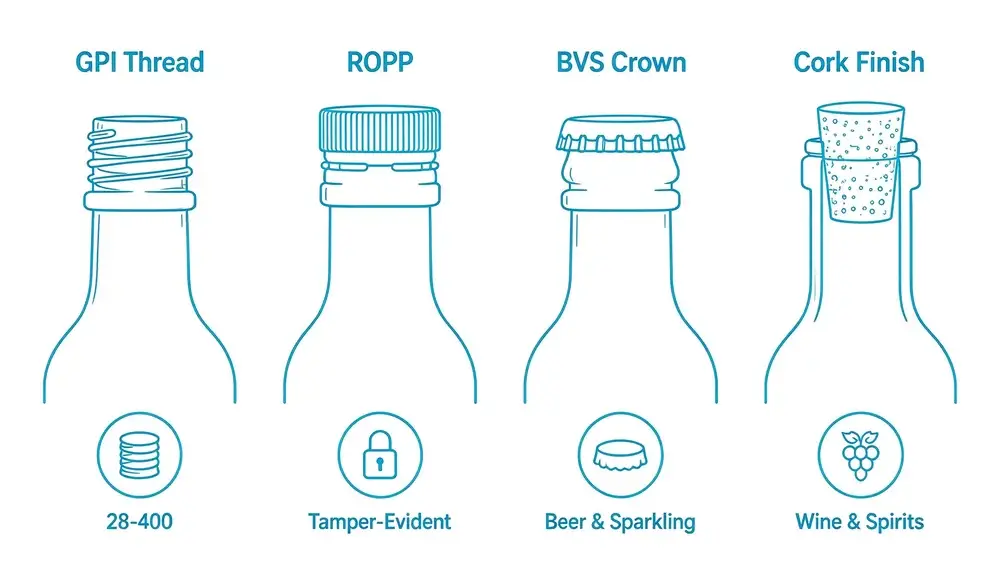
Glass bottles use four main sealing systems, each with its own size specifications and not interchangeable.
- GPI (Glass Packaging Association) continuous thread. The primary closure for food, cosmetic, and pharmaceutical bottles. Specify with two numbers: diameter + thread style. 28-400 means a 28mm diameter with GPI 400 thread. The thread pattern determines how many rotations are needed to seal, thread depth, and pitch.
- ROPP (Roll-On Pilfer-Proof). The aluminum cap is rolled directly onto the threaded bottle neck on the capping machine. Spirits, wine, and olive oil use this as the standard tamper-evident closure. Common sizes: 25mm, 28mm, 30mm, 31.5mm. The aluminum cap leaves the factory as a smooth shell; threads are formed on the bottle neck during the sealing process.
- BVS / Crown Cap. Press-in crown closure used for beer, cider, and sparkling beverages. Available in pry-off and screw-off types. Standard sizes: 26mm, 29mm.
- Cork bottle mouth. Straight bore for natural or synthetic cork stoppers. Cork diameter sizing: #7 (19mm), #8 (20.5mm), #9 (22mm), #10 (23.5mm).
Overview of GPI Thread Sizes
The GPI system is named by two parts—diameter and thread style—and the bottle and cap must match exactly on both.
Common sizes for glass bottle procurement:
- 18-400: Dropper and sample bottles (5–30ml)
- 20-400: Small cosmetic and medicine bottles (10–60ml)
- 22-400: Small cosmetic bottles (15–60ml)
- 24-400: Medium bottles (60–250ml) — Woozy bottles, small Boston round bottles
- 28-400: The most common large bottle size (120–1000ml) — Boston round bottles, jars
- 33-400: Wide-mouth jars (250–1000ml)
- 38-400: Extra-large wide-mouth jars (500ml+)
Thread styles (400, 410, 415, 425, 444) differ in the number of tightening turns, thread depth, and pitch. The cap from a 28-400 bottle cannot screw onto a 28-410 neck, even though the diameter is identical. Both numbers must match.
Why "28mm" Doesn't Guarantee Compatibility
The most common mismatch reason is the assumption that matching diameters is enough. In reality, it is far from sufficient. Here are the specific pitfalls:
- Same diameter, different thread style. A 28-400 cap will not mesh with a 28-410 neck—the thread pitch and profile differ. This is the number one cause of cap mismatches.
- Metric vs. imperial confusion. Some caps use imperial sizes that are close to but not identical to metric equivalents. 24mm is close to 1 inch but not 1 inch. Never convert on your own—use the exact GPI designation.
- Tolerance differences between plastic and metal caps. Plastic continuous-thread caps tolerate dimensional deviations relatively well. Aluminum ROPP caps do not—the bottle neck inner diameter tolerance must be within ±0.15mm. Even a slight deviation can prevent a proper ROPP fit or cause inconsistent seals.
- Security band interference. The tamper-evident ring on ROPP caps must cross the bottle neck bead. If the bead is too high or misaligned, the cap will not seat fully.
- Gasket mismatch. Caps come with various gasket materials—EPE foam, pulp/polyethylene, pressure-sensitive liners, and induction seals. The gasket must match the bottle's sealing surface. Cork bores and flat-top GPI necks require different gaskets. The wrong choice leads to poor sealing and leakage.
How to Correctly Specify Bottle Neck Finish
When ordering glass bottles, clearly state these five items:
- Sealing system: GPI, ROPP, BVS, or cork.
- Full designation: write "28-400", not "28mm".
- Tolerance requirement: ROPP requires specifying the neck inner diameter tolerance (typically ±0.15mm).
- Sealing surface type: flat top (CT finish), crown lip (crown finish), or cork bore.
- Reference cap model: if possible, specify the exact model—"Compatible with manufacturer cap 28-400-ALU-ROPP"—eliminates ambiguity entirely.
Conduct a Trial Assembly Before Bulk Production
Before mass production begins, draw 50 bottles and 50 caps from the production lot for trial testing. Check four items:
- Thread engagement: Does the cap screw smoothly through the full number of turns?
- Leak test: Fill with water, cap, invert, and apply light pressure. No dripping or seepage.
- Cross-threading risk: Will a hurried operator force the wrong thread on the line? If so, the thread profile may be too shallow—problems are inevitable on the production line.