
Glass Packaging Insights
Guides & Insights
Glass Bottle Container Loading: Packing More into Each Shipment and Paying Less for Freight
The most important number for glass bottles imported by sea is: how many bottles can a container actually hold?
The single figure that matters most when you ship glass bottles by sea is how many units you can pack into one container. New importers almost always assume the answer comes down to space. In practice it is the opposite — glass is dense and heavy, so nearly every load hits the weight ceiling before the container ever looks full. Plan around that reality and you can trim the freight you pay per bottle by roughly 15 to 30 percent.
Container types and loading capacity
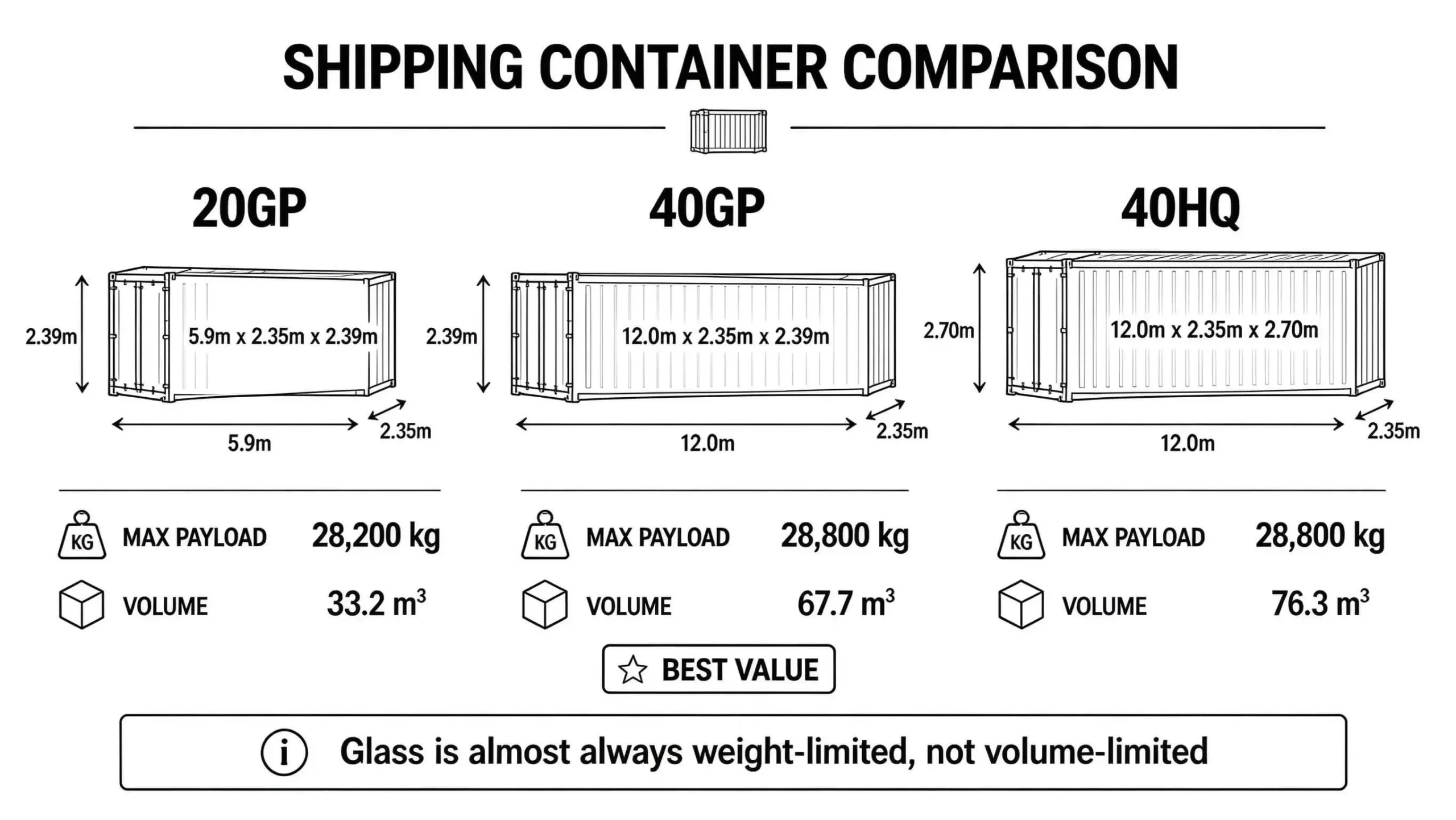
Three standard dry cargo boxes are common for glass bottle shipping:
- 20GP: roughly 5.9m × 2.35m × 2.39m inside, around 28,200kg of payload, and 33.2m³ of volume.
- 40GP: roughly 12.0m × 2.35m × 2.39m inside, around 28,800kg of payload, and 67.7m³ of volume.
- 40HQ (high-cube): roughly 12.0m × 2.35m × 2.70m inside, around 28,800kg of payload, and 76.3m³ of volume.
One detail is easy to miss: the 40GP delivers almost twice the interior volume of the 20GP, yet its payload allowance only grows by about 600kg. For a heavy product like glass, the 40GP is nearly always the smarter choice — the rate runs only about 30% higher while it can carry close to double the bottles.
Volume limit versus weight limit
When a container is packed full of cartons but is still far from its weight allowance, the load is volume-limited. When the cargo uses up the maximum weight first while space remains inside, it is weight-limited.
Each glass bottle runs anywhere from 50g to 1,500g, and cartons and pallets only add more. Even small bottles consume the allowance fast. A few real-world examples:
- A 750ml wine bottle (460–560g): a 20GP holds roughly 20,000–25,000 pieces, using just 40–50% of the available space. The rest is air — and you pay freight for that air.
- A 100ml Boston round (85–100g): a 20GP takes about 60,000–80,000 pieces, coming close to the volume ceiling, though it is still most likely weight-limited first.
- A 50ml dropper bottle (85–108g): a 20GP holds around 50,000–65,000 pieces.
A useful rule of thumb: once each bottle tops roughly 300g, plan around the weight limit.
Five strategies to raise your loading rate
1. Lightweighting the bottle
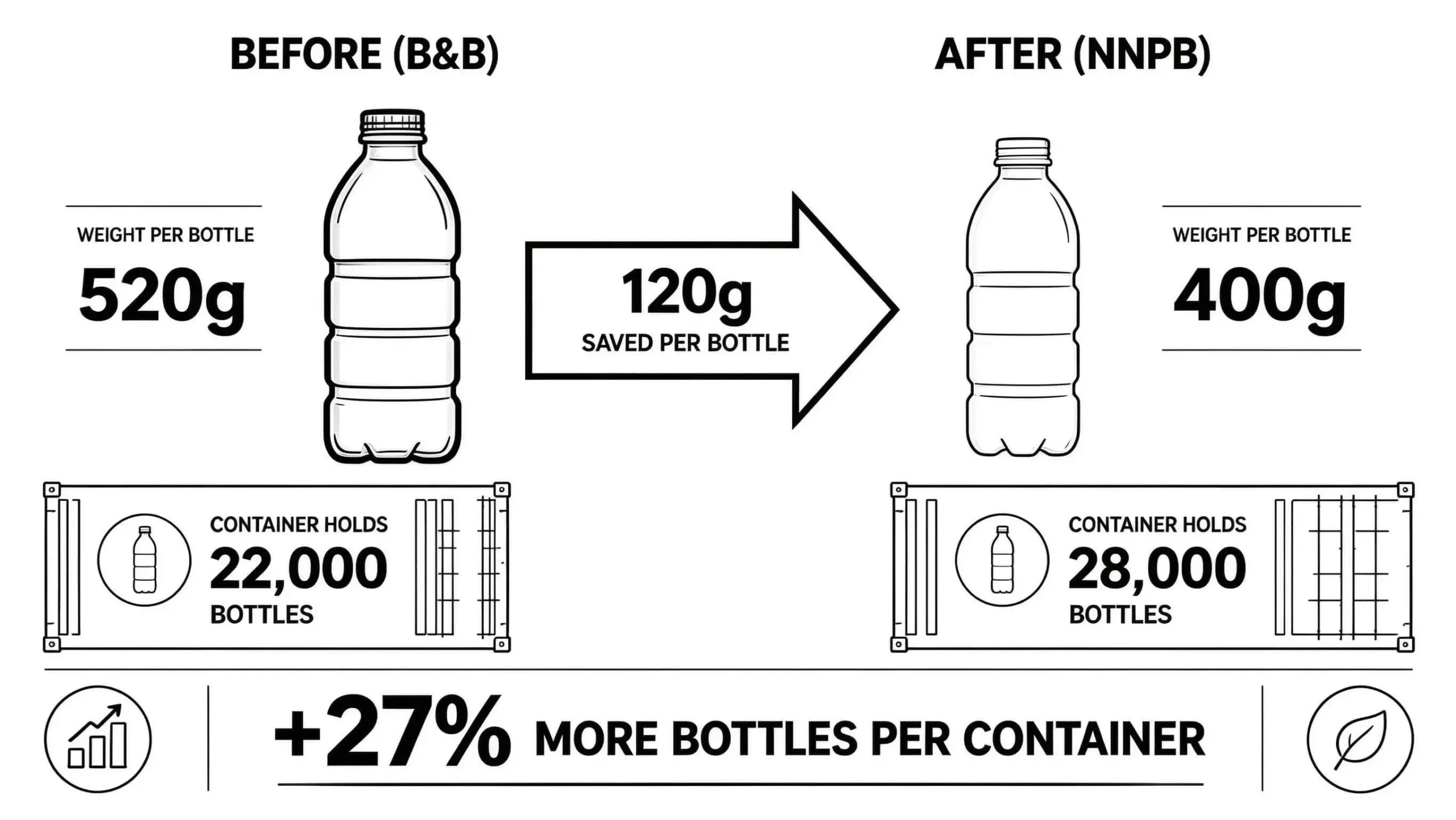
This is the single biggest lever. Switching from blow-and-blow (B&B) production to narrow-neck press-and-blow (NNPB) typically cuts 20–35% of the weight with no loss in performance. Lighter bottles let you reload the container before the weight ceiling gets in the way.
Take a 750ml Bordeaux bottle as an example:
- At 520g, a 20GP holds about 22,000 bottles.
- After lightweighting down to 400g, a 20GP holds about 28,000 bottles.
That is 27% more stock per container — the same as a 27% reduction in your per-bottle freight. Ask the supplier whether your bottle shape supports NNPB; not every profile qualifies, but most standard round bottles do. A lightweight calculator can then project the savings for your exact bottle.
2. Optimizing the carton configuration
The size of the carton decides how many boxes fit on one pallet, which in turn decides how many pallets fit in the container. Small tweaks repeat across dozens of pallets, so the gains pile up quickly.
- Test different bottles-per-case counts (6, 12, or 24) and pick the layout that wastes the least pallet area.
- Cartons should cover the pallet edge to edge. A 5cm gap on every side, multiplied across more than 20 pallets, quietly sacrifices a large amount of space.
- Round bottles can be packed in a honeycomb or staggered pattern, adding 5–10% per carton.
3. Choosing the right container size
Match the box to your bottle count:
- Under 15,000 bottles: a 20GP is enough.
- 15,000–50,000 bottles: the 40GP gives the best cost per unit.
- Tall bottles or tall cartons: go with the 40HQ, which adds roughly 31cm of interior height.
Whatever you pick, always compare per-bottle freight — the total container cost divided by the number of bottles. Measured that way, the 40GP wins almost every time.
4. Mixed loading
If you order several bottle styles at once, packing them together in one container lets you push both weight and volume use to the limit. Heavy, compact items — small dropper bottles and jars — go on the bottom layer, while lighter, taller pieces like wine bottles sit on top. The goal is to keep the weight allowance and the space allowance close to their limits at the same time.
5. Understanding how freight is priced
Full-container-load (FCL) sea freight is quoted per container — not per kilogram and not per cubic meter. A half-empty 40GP costs exactly the same as a completely full one, so every vacant position is money thrown away.
LCL, by contrast, is charged on whichever is greater: volume or weight. Glass bottles almost always fall on the weight side. Build this into your cost model from the very first estimate.
Checklist before you place the order
Ask the supplier for the following information:
- Exact carton dimensions (length × width × height in mm).
- Bottles per carton and the gross weight of each carton (kg).
- The pallet standard (Euro or industrial), bottles per pallet, and total height of a loaded pallet.
- The recommended container type and the estimated total bottle count.
- The loaded pallet weight, confirmed to stay below the container's floor load limit.
Feeding this data into a container loading calculator takes about 30 minutes and can save thousands of dollars in freight every year — and your per-bottle cost model now stands on hard numbers instead of guesswork.